
Apply for an Austrian Diplomatic Passport
Apply for an Austrian Diplomatic Passport 2026: Quantum Security & Global Protocols
The Austrian passport is already ranked among the safest in the world, but the 2026 Diplomatic Edition has set a new global benchmark. Having recently won the KSÖ Security Prize, the new document features proprietary security elements designed to resist even future quantum-computing forgery attempts.
However, to apply for an Austrian Diplomatic Passport, one must meet stringent legal requirements defined by the Federal Ministry for European and International Affairs (BMEIA). Here is the 2026 status report on eligibility, security, and the application lifecycle.
1. 2026 Eligibility: Who Qualifies?
Under the Austrian Passport Act, diplomatic passports are not a right of citizenship but a tool of the state. Eligibility is strictly limited to:
- High-Ranking Officials: The Federal President, members of the Federal Government, and presidents of the legislative bodies.
- Diplomatic Staff: Career diplomats and consular officers posted abroad.
- Special Envoys: Individuals representing the Republic of Austria on high-level international missions or within organizations like the UN, EU, or OSCE.
- Family Members: Spouses and dependent children of diplomats posted abroad, provided they are part of the same household.
2. The “Quantum-Proof” Security Features
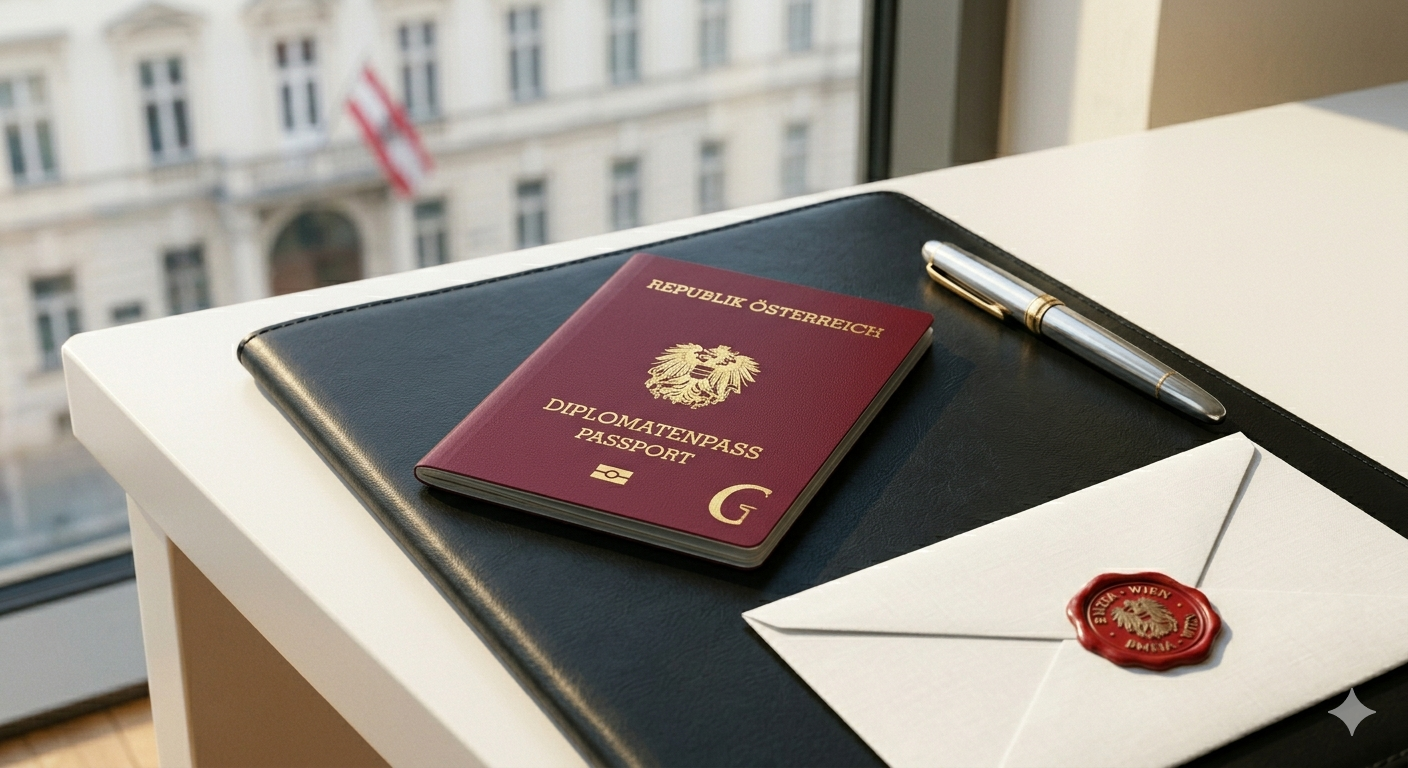
The 2026 Austrian Diplomatic Passport (distinguishable by its unique cover and “Diplomatenpass” designation) includes:
- NFC-Front Integration: The contactless chip has moved to the front cover for faster, more secure scanning at diplomatic channels.
- The “CHECK-AT” Protocol: A secure QR code on the polycarbonate data page allows instant verification via the Ministry of the Interior’s app.
- Quantum Protection: Developed by the Austrian State Printing House (OeSD), the document uses a proprietary security thread that protects biometric data against future high-velocity decryption.
- “AUSTRIA” Fan-Effect: When the pages are fanned out, the word “AUSTRIA” becomes visible on the edges—a simple yet effective physical anti-counterfeit measure.
3. The Application Protocol (BMEIA)
Applying for a diplomatic passport follows a separate track from standard civilian documents:
- Official Request: An application must be supported by an official note (Note Verbale) from the relevant department or international mission.
- Biometric Enrollment: Despite the diplomatic status, physical appearance is mandatory for the capture of 2026-standard high-resolution fingerprints and iris patterns.
- The “D-Visa” Synchronization: For officials entering Austria on a diplomatic mission, the BMEIA now streamlines the passport issuance with the digital D-Visa system for 48-hour turnarounds.
4. Fees & Validity
Diplomatic passports are generally issued free of administrative taxes for those on official state business.
- Validity: Typically issued for 5 to 10 years, depending on the length of the official’s mandate or posting.
- Return Mandate: Unlike civilian passports, a diplomatic passport must be returned to the BMEIA immediately upon the termination of the official function that justified its issuance.
How Mercurial Global Passport Facilitates Global Missions
Managing diplomatic credentials requires discretion and technical precision. At Mercurial Global Passport, we support international organizations and state representatives with:
- Protocol Liaison: We coordinate between your mission and the BMEIA to ensure all “Note Verbales” and supporting credentials meet 2026 standards.
- Legalization via Diploma Shop: For family members or officials with foreign civil records, our Diploma Shop provides Apostilles and Certified German Translations that are pre-vetted for acceptance by Austrian federal authorities.
- Security Logistics: We manage the secure, trackable transit of sensitive identity documents through diplomatic-grade courier channels.
[Consult Our Diplomatic Specialists – Elevate Your Global Mobility]
